
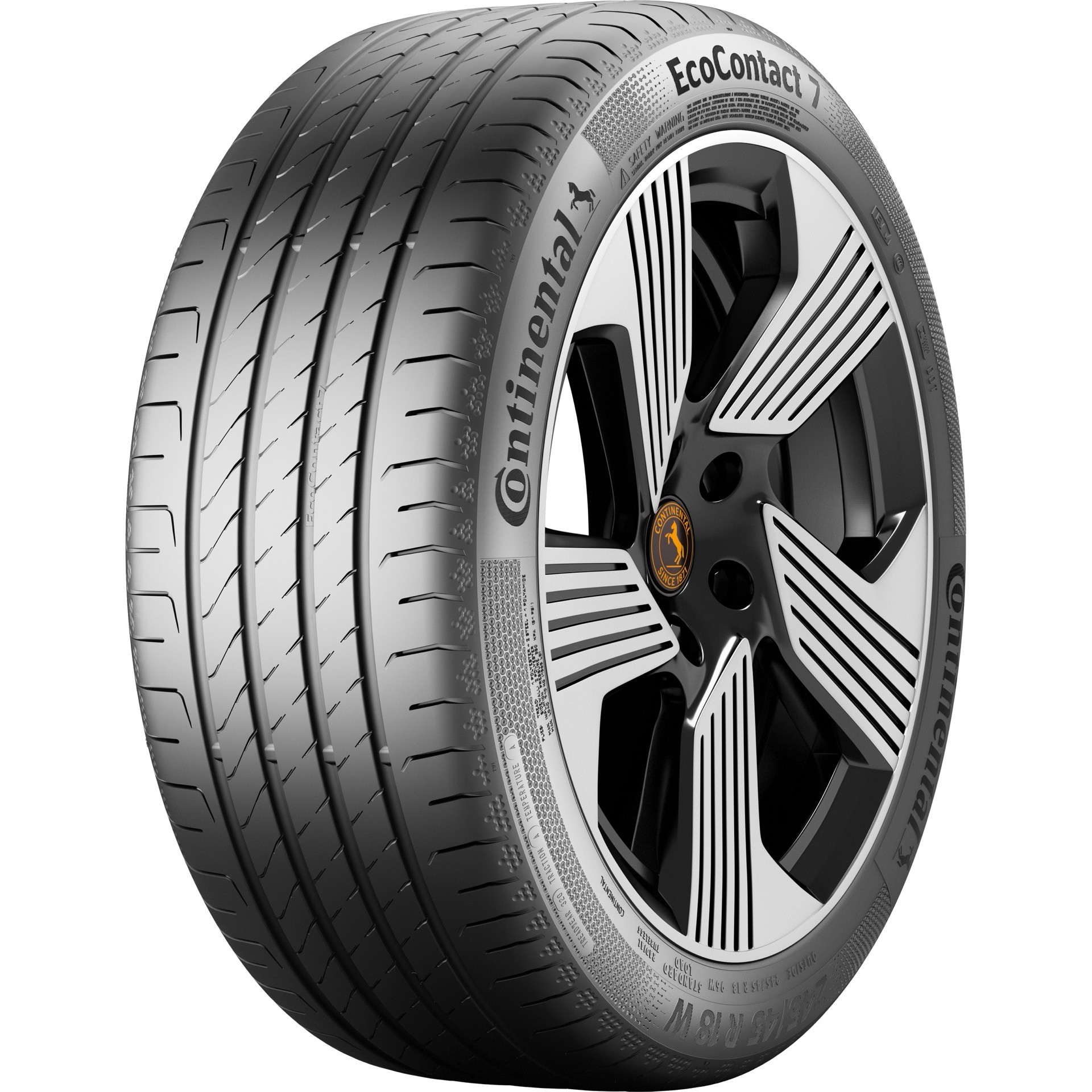
Continental and Renault Group have announced a partnership aimed at reducing rolling resistance in electric vehicles. The two companies co-developed a tyre based on the Continental EcoContact 7 that achieves up to 35% lower rolling resistance than what is required for the EU tyre label’s top A rating — and, according to Continental, adds around 30 km of driving range to a vehicle with a 500 km battery.
☰
How much of a difference does rolling resistance actually make?
Rolling resistance accounts for 20 to 30% of a vehicle’s total energy consumption — a figure that applies to both combustion and electric cars. For EVs, however, the impact is more direct: lower resistance means fewer watt-hours per kilometre, which translates to longer range without a larger battery. Continental claims the adapted EcoContact 7 delivers approximately 30 additional kilometres per charge for an EV with a 500 km rated range — a distance Continental likens to the Paris-Versailles route.
What Continental changed in the EcoContact 7
The starting point was the production EcoContact 7, which Continental modified specifically for Renault’s requirements. Three areas were reworked: a specially modified tread compound, a customised sidewall design, and an optimised tyre construction. Continental has not disclosed the exact specifications of the modifications, describing it as a “custom-engineered” version for Renault’s innovation teams rather than a production variant.
“Together with Renault Group, we are improving the efficiency of its new electric vehicles. Our tailor-made tyres have very low rolling resistance, which significantly increases range,” said Dr. Christian Strübel, Continental’s expert in tyre rolling resistance.
| Metric | Value |
|---|---|
| Rolling resistance improvement vs EU A-rating threshold | Up to 35% lower |
| Additional range (500 km battery vehicle) | ~30 km per charge |
| Rolling resistance share of total energy consumption | 20–30% |
| Test tyre savings via virtual development (Continental, annual) | Up to 10,000 units |
Virtual development: simulators replace physical test tyres
The development process relied heavily on simulation rather than physical testing. Continental’s Driver-in-the-Loop simulator was used to evaluate and optimise tyre characteristics at an early stage, while Renault Group contributed its ROADS driving simulator to replicate real-world conditions in a reproducible virtual environment. By combining both systems, the companies say they could replicate test scenarios across each other’s platforms and speed up the overall development cycle.
Continental states it currently saves up to 10,000 physical test tyres per year through virtual development methods — a figure that reduces material waste and development time. The adapted EcoContact 7 was unveiled at Renault Group’s “Sustainability Tour” event on 8 June 2026 in Guyancourt, near Paris, as part of the carmaker’s “Garage Futurama” innovation platform, of which Continental is a technical partner.
What this means for EV drivers
It is worth noting that this adapted tyre is a development exercise and concept demonstration — Continental and Renault have not announced a production timeline or consumer availability for this specific version. The standard Continental EcoContact 7 already holds an A rating for rolling resistance on the EU tyre label and is available across a wide range of sizes. Continental is also the OE tyre supplier to all 10 of the top-selling EV brands in EMEA, which gives the partnership broader commercial context.
Nicolas Champetier, VP Innovation at Renault Group, commented: “Extremely low rolling resistance is key to enhancing the range of electric vehicles. With Continental, we have a strong partner by our side: thanks to our long-standing collaboration in original equipment, we can jointly develop solutions that provide tangible efficiency gains for drivers.”